
NourishNet's Quantum Nose Technology (Coming Soon!)
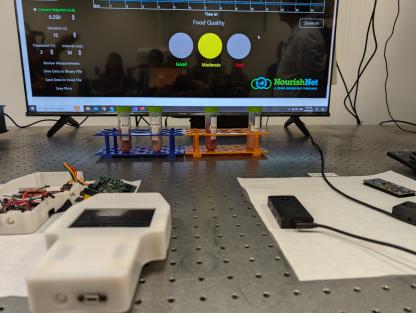
The Quantum Nose is a portable, handheld electronic sensor, created by Cheng Gong, a University of Maryland (UMD) engineer, which uses advanced physics to detect if foods are still fresh. The sensor is integrated with a new app that can match the food to a community pantry.
If the nose sniffs spoilage, the food item can be composted or converted into fertilizer or bioenergy through a system developed by a professor of environmental science and technology at UMD.
NourishNet's FoodLoops Technology (Coming Soon!)
FoodLoops is the app and platform, which focuses on engaging consumers, recovering and redistributing surplus food, and providing greenhouse gas emission data to government and institutions to allow for data-driven decision-making.
For example, it connects small farmers within the food ecosystem with nonprofits and their clients; people who need food can see a map with the pantries where they can search for produce they need. If those pantries don't carry those fruits or vegetables, they can add them to a wishlist, and the food pantry will be notified.
NourishNet's Consumer Education
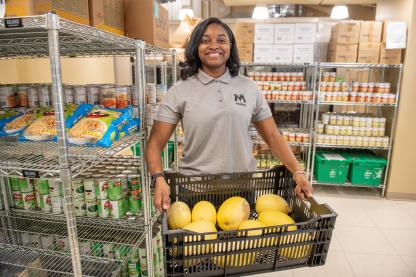
Our food waste prevention approach targets the source through strategic consumer education in partnership with local food pantries, college campuses, and community organizations interested in providing targeted food waste reduction education to their clients and audiences.
We prioritize strategies that make the most impact: clarifying confusing food date labels, sharing creative ways to use leftovers, and teaching proper food storage and smart shopping techniques. These efforts particularly benefit food-insecure communities, helping them maximize their food budgets and resources.
By bridging research and real-world application, we're working towards sustainable, scalable solutions to reduce food waste across communities.